
Cyberpunk 2077: The Price of Becoming Someone in a City That Sells Everything
1. In Night City, Being Nobody Is the Worst Thing You Can Imagine
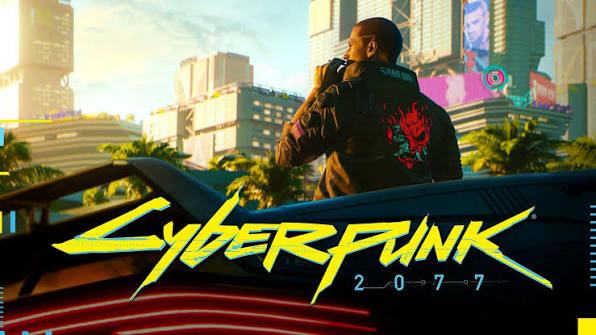
Night City does not look like a place where people come to find themselves. It looks like a place where they come to become something worth looking at. Neon advertisements climb across towering buildings. Luxury vehicles move through streets crowded with people who have learned to make themselves visible in a world that rarely pays attention to anyone without money, influence, or a reputation. Expensive apartments overlook neighborhoods where survival can depend on the next job. Technology promises to improve the human body, extend its capabilities, and perhaps even preserve the mind beyond death. Everywhere you look, somebody is selling a better version of life. And yet, almost everyone seems desperate.
This contradiction is at the heart of Cyberpunk 2077. Night City is a place of extraordinary possibilities, but those possibilities come with a price. People can replace parts of their bodies with advanced machinery, purchase experiences through digital entertainment, and build reputations that turn their names into valuable commodities. They can become stronger, faster, richer, and more dangerous. What they cannot easily buy is the certainty that any of those improvements will make their lives meaningful. The game introduces V, a mercenary trying to establish a name in a city where reputation can determine which doors open and which jobs become available. V is not a chosen hero arriving to save civilization. They are a person attempting to climb a brutal social ladder, taking dangerous work in the hope that success will eventually lead to something better. The official premise describes Night City as a metropolis obsessed with power, glamour, and body modification, where V's choices shape the story and the people around them.
That ambition is easy to understand. Nobody wants to remain invisible forever. V wants a future, and Night City offers an appealing image of what that future might look like: enough money to stop worrying, enough status to be respected, and enough power to avoid being treated as disposable.
The problem is that Night City has built an entire economy around selling this dream. Everywhere V turns, someone is offering a shortcut to success. Fixers promise lucrative jobs. Corporations present themselves as gateways to security and advancement. Criminal organizations offer protection, belonging, or influence. Even the city's most celebrated legends become part of a marketplace in which their reputations can be traded, exploited, and remembered long after their actual lives have ended. In this environment, becoming somebody is not simply a personal ambition. It is a form of survival. But the more V pursues recognition, the more complicated the original desire becomes. Is the goal to build a life worth living, or merely to become important enough that other people cannot ignore you? Cyberpunk 2077 begins with the fantasy of becoming a legend. Its most compelling questions emerge when that fantasy starts to fall apart.

2. The City Does Not Need to Hate You to Destroy You
The cruelty of Night City is rarely personal.
A powerful corporation does not need to know who you are to make your life worse. A wealthy executive does not need to understand your ambitions before deciding that they are irrelevant. The system can damage people without ever acknowledging their existence, because individual suffering is not necessarily a problem for an institution designed to protect its own interests.
This is what makes the setting more unsettling than a conventional story about a corrupt villain. A villain can be defeated. A system can survive the people who expose it. Night City operates through layers of unequal power. Corporations possess resources and influence far beyond what ordinary citizens can hope to acquire. Security is a privilege that can be purchased, while vulnerability is often treated as an unfortunate personal failure. People who lack money or connections must navigate an environment in which almost every opportunity carries some kind of risk.
V's profession reflects this reality.
Mercenary work provides a way to earn money and build a reputation, but it also places V inside the machinery of other people's ambitions. Jobs arrive through fixers who connect clients with people willing to perform dangerous tasks. A mission may appear straightforward when described in advance, yet its consequences can extend far beyond the immediate payment. V may be hired to steal something, eliminate a target, retrieve information, or resolve a problem that somebody with greater resources would rather not handle personally. The work offers a path upward, but it also makes V dependent on the same structures that create the danger. This is one of the game's sharpest observations about power: being useful to powerful people is not the same as being protected by them. A mercenary may be valuable today and expendable tomorrow. A corporation may reward an individual while that individual serves its interests, then discard them when circumstances change. A criminal organization may offer a sense of belonging while demanding loyalty that becomes increasingly difficult to maintain.
The danger does not always come from a direct confrontation. Sometimes, it comes from realizing that the relationship was never equal in the first place. The city is full of people trying to gain control over their lives, but many of the available routes toward control require them to become participants in someone else's system. That creates a painful cycle. People accept dangerous work because they need money. They need more money because survival is expensive. They take greater risks because they want to escape the conditions that made the first risks necessary. Eventually, the pursuit of a better life can become another mechanism that keeps them trapped. The game does not suggest that ambition itself is foolish. V's desire to improve their circumstances is understandable, and the ability to make choices in a difficult environment is an important part of the role-playing experience. The more uncomfortable question is whether a person can achieve genuine freedom while pursuing success according to rules designed by people who already possess most of the power. Night City rarely offers an easy answer.
3. Jackie Welles and the Dream That Makes the City Feel Human
Before Night City becomes a sprawling landscape of corporations, dangerous technology, and competing ambitions, it becomes personal through V's relationship with Jackie Welles.
Jackie is important because he gives the dream of becoming somebody a human face.
He wants success, but his ambition is not simply about accumulating wealth. He imagines a future in which he and V rise above their current circumstances, earn enough to be respected, and become names people recognize. His confidence makes the possibility feel real. He is the kind of friend who can turn a dangerous plan into an exciting prospect simply by believing that the two of you might actually pull it off.
That belief is part of what makes their partnership compelling.
Jackie does not need a complicated philosophical argument to explain why he wants more from life. He wants to escape the limitations placed on him. He wants to make his mother proud, enjoy the rewards of his work, and become someone whose life has amounted to something.
These are not unreasonable desires. In a city where ordinary people are constantly reminded of what they lack, the dream of rising above one's circumstances can be a source of hope. It gives danger a purpose. It turns difficult work into an investment in a future that seems worth reaching. Jackie helps V believe that future is possible.
Their relationship also establishes an important contrast with the city around them. Night City treats relationships as potential liabilities, sources of information, or opportunities for manipulation. Jackie, by contrast, offers something more personal: trust. Trust does not make him invulnerable. In a world structured around risk and unequal power, it can make a person vulnerable in precisely the ways that matter most. But it gives the dream of success an emotional dimension that money and reputation cannot provide. A legend may be remembered by thousands of strangers. A friend remembers the person who existed before the legend.
That difference changes how we understand V's ambition. The goal is no longer only about climbing the social hierarchy. It is also connected to the people who share the journey and the possibility of building something meaningful together. Jackie's presence reminds us that ambition often begins as a shared dream. People imagine a better future not only because they want more for themselves, but because they want the people they care about to experience something better as well. Night City is very good at turning those dreams into motivation. It is much less reliable at allowing people to enjoy the lives they imagined.
4. When the Future You Wanted Stops Belonging to You
The turning point in V's story comes through a job that promises to change everything. The plan involves stealing an experimental implant, a piece of technology valuable enough to attract the attention of people with enormous resources. The operation goes wrong, and V ends up with a prototype known as the Relic embedded in their head. Its digital engram contains the personality and memories of Johnny Silverhand, whose presence begins to threaten V's own continued existence. Suddenly, the question of becoming somebody takes on a disturbing new meaning. V has spent time trying to build an identity through work, relationships, and reputation. Now another person's identity is literally occupying space inside their mind. Johnny is not simply a rival or an enemy waiting somewhere in the city. He is a presence V cannot easily escape, a voice that challenges their decisions and a personality that threatens to overwrite their own. The conflict transforms the game's central ambition.
At the beginning, V wants to become important enough to secure a future. After the Relic enters the picture, the immediate goal becomes more basic: remain alive long enough to have a future at all. That shift strips away some of the glamour surrounding the mercenary lifestyle. Reputation becomes less important when time is running out. Expensive upgrades lose some of their appeal when the body they enhance is under threat. The possibility of becoming a legend remains attractive, but it becomes increasingly difficult to ignore the possibility that V may not survive to enjoy whatever that legend is supposed to represent. The Relic also introduces a more intimate form of uncertainty.
What makes a person themselves? Is identity determined by memory, personality, physical continuity, or the decisions someone makes while living through a particular set of experiences?
Johnny has memories and recognizable traits. He possesses opinions, regrets, prejudices, and desires. He is not an empty recording that repeats a sequence of predetermined responses. Yet his existence also raises the uncomfortable possibility that the persistence of a personality does not automatically guarantee the continuation of the person who once possessed it.
V's situation makes these questions immediate rather than abstract. The struggle is not simply about protecting a body. It is about preserving the boundary between two people whose identities are becoming increasingly entangled. The technology that promises a form of immortality creates a terrifying possibility: a person might survive as information while losing control over what that information means. Night City sells the fantasy that human limitations can be overcome through technological advancement. The Relic reveals the cost hidden inside that fantasy. Perhaps the future can preserve aspects of a person. But who gets to decide whether the result is still them? And if the technology can overwrite one identity with another, what exactly has been saved?
5. Johnny Silverhand Is Not the Answer to V's Problems
Johnny Silverhand could easily have been written as a straightforward symbol of rebellion.
He is a famous rockerboy, an enemy of powerful corporations, and a figure whose reputation has survived long after his original life ended. He has the attitude of someone who refuses to accept the rules imposed by institutions he despises. His presence offers a direct challenge to the corporate order that defines Night City.
But Johnny is not a simple solution to the world that produced him.
His hatred of corporations is understandable, yet his own behavior frequently reveals how difficult it is to separate rebellion from ego. He can be courageous and insightful, but he can also be selfish, dismissive, and convinced that his perspective deserves priority over everyone else's.
He knows how to oppose authority. He is less consistent when it comes to understanding the people affected by his choices.
That contradiction makes his relationship with V far more interesting than a conventional partnership between hero and mentor.
At first, Johnny's presence feels like an invasion. V has not chosen to share their mind with him, and his opinions arrive without permission. He challenges V's decisions, pushes his own interpretations of events, and treats their shared circumstances as an opportunity to continue a struggle that began decades earlier.
The relationship is inherently unequal in a strange way. Johnny has access to V's immediate experience, while V must gradually learn how to interpret Johnny's memories and motivations. Both characters possess information the other needs, but neither can assume that the other's version of events is complete.
Over time, this creates the possibility of understanding without guaranteeing friendship.
V can recognize Johnny's pain without accepting every conclusion he draws from it. Johnny can begin to see V as a person rather than merely an obstacle or an instrument. Their arguments can reveal shared fears, conflicting priorities, and uncomfortable similarities.
The result is a story about identity that does not depend on pretending either character has discovered the correct way to live.
Johnny's rebellion does not automatically make him free. His fame has preserved his image, but it has not resolved his regrets. He can condemn the corporate world while remaining trapped inside his own patterns of behavior.
V, meanwhile, must confront a different danger: the possibility that survival may require accepting help from someone whose values and actions are difficult to trust.
Their relationship challenges the idea that a strong identity must be completely independent.
Sometimes, understanding who you are requires encountering someone who disagrees with you. Sometimes, that encounter forces you to reconsider parts of yourself you would rather leave untouched.
But there is a difference between being changed by another person and disappearing into them.
For V, that difference becomes a matter of survival.
6. Cyberware and the Fear of Being Ordinary
In Night City, the human body is both a personal possession and a public statement.
Cyberware allows people to enhance their physical capabilities, replace damaged parts, and develop abilities that would otherwise be impossible. For V, these upgrades are also an important part of gameplay. New implants can change how combat feels, opening different approaches to movement, defense, hacking, and direct confrontation.
The appeal is obvious. A stronger body means more options. A better set of implants can turn an overwhelming encounter into a manageable one. The player can shape V's capabilities around a preferred style, gradually creating a character who feels distinct from other mercenaries.
Yet the setting gives these improvements a meaning beyond their mechanical advantages.
Night City is a place where being ordinary can feel like a disadvantage. If someone else has better equipment, stronger connections, or access to more advanced technology, your own abilities may seem inadequate. Enhancement becomes a way to compete, but competition ensures that the definition of adequacy keeps changing.
Once an improvement becomes common, something more powerful is needed to stand out.
The body becomes another arena in which people are encouraged to pursue an endless cycle of upgrades. There is always a more capable version of yourself to imagine, and the distance between who you are and who you could become becomes another opportunity for somebody to sell you something.
This creates an unsettling parallel between cyberware and the pursuit of reputation.
Both promise to make a person more valuable. Both can provide genuine advantages. And both can encourage the belief that the current version of yourself is never enough.
The game does not suggest that cybernetic enhancement is inherently bad. Its combat systems are built around the creative possibilities of technological modification, and experimentation is one of the most enjoyable aspects of developing V. The more interesting distinction is between using technology because it serves your goals and pursuing it because you have been convinced that you must constantly improve to deserve a place in the world. A cybernetic implant can expand what V is capable of doing. It cannot, by itself, determine what V should do with those capabilities.
That decision remains personal. The same principle applies to money, reputation, and power. They can change the circumstances in which a person lives, but they cannot automatically resolve the question of what makes that life worthwhile. Night City is full of people who have become stronger without becoming happier, more famous without becoming more understood, and more powerful without escaping their dependence on the systems that reward them. Their existence makes the city's promise of self-improvement feel increasingly complicated.
7. The Side Stories That Reveal What the Main Story Cannot
The main narrative gives V an urgent reason to keep moving. Yet some of Cyberpunk 2077's most affecting moments emerge when the player steps away from that urgency.
Night City contains people whose lives cannot be reduced to V's struggle for survival. Their stories involve relationships, personal compromises, failed ambitions, grief, exploitation, and the consequences of decisions made long before V entered the picture.
These encounters change the scale of the world.
A major mission might involve powerful people competing over an extraordinary piece of technology. A smaller story might concern someone trying to preserve a relationship, make sense of a loss, or escape a situation that has gradually become unbearable.
The second kind of story can feel just as important as the first because it brings the game's larger themes into ordinary human circumstances.
Consider the difference between knowing that a city is exploitative and meeting a person whose life has been shaped by exploitation. The first is an observation about a system. The second asks you to consider what that system actually does to someone.
The distinction is important because Night City can sometimes seem so overwhelming that individual suffering risks becoming part of the scenery. Its crowded streets, neon advertisements, and constant violence create an atmosphere in which extraordinary things happen so frequently that they can begin to feel normal.
Personal stories interrupt that normalization.
They encourage the player to stop treating the city as a collection of opportunities and threats and start considering the people who live inside it.
Not every encounter offers a clean resolution. Not every character can be rescued, and not every difficult situation has an outcome that feels entirely fair. Sometimes, the player must choose between imperfect possibilities without knowing whether the decision will produce the result they intended.
That uncertainty reinforces the game's larger concerns.
V is not powerful enough to repair Night City through individual acts of kindness. A successful intervention in one person's life does not erase the larger conditions that made their suffering possible. But the inability to solve everything does not make individual choices meaningless.
Helping one person can matter even when the system remains unchanged.
This is an important counterpoint to the pursuit of legendary status. A legend is defined by the scale of their reputation, by how many people recognize their name and how dramatically their actions affect the world.
A meaningful life can be measured differently.
It can be found in a promise kept, a person treated with dignity, or a moment when someone is allowed to make a decision for themselves. Such actions may never become part of a public reputation. They may not produce money, fame, or a lasting record of achievement.
But their value does not depend on being celebrated.
Through its smaller stories, Cyberpunk 2077 gives the player opportunities to consider whether the desire to change the world has overshadowed the importance of the people already standing within it.
8. Night City Is Designed to Make You Look Up
One reason Night City remains so memorable is that its architecture constantly encourages the player to compare different versions of the same world.
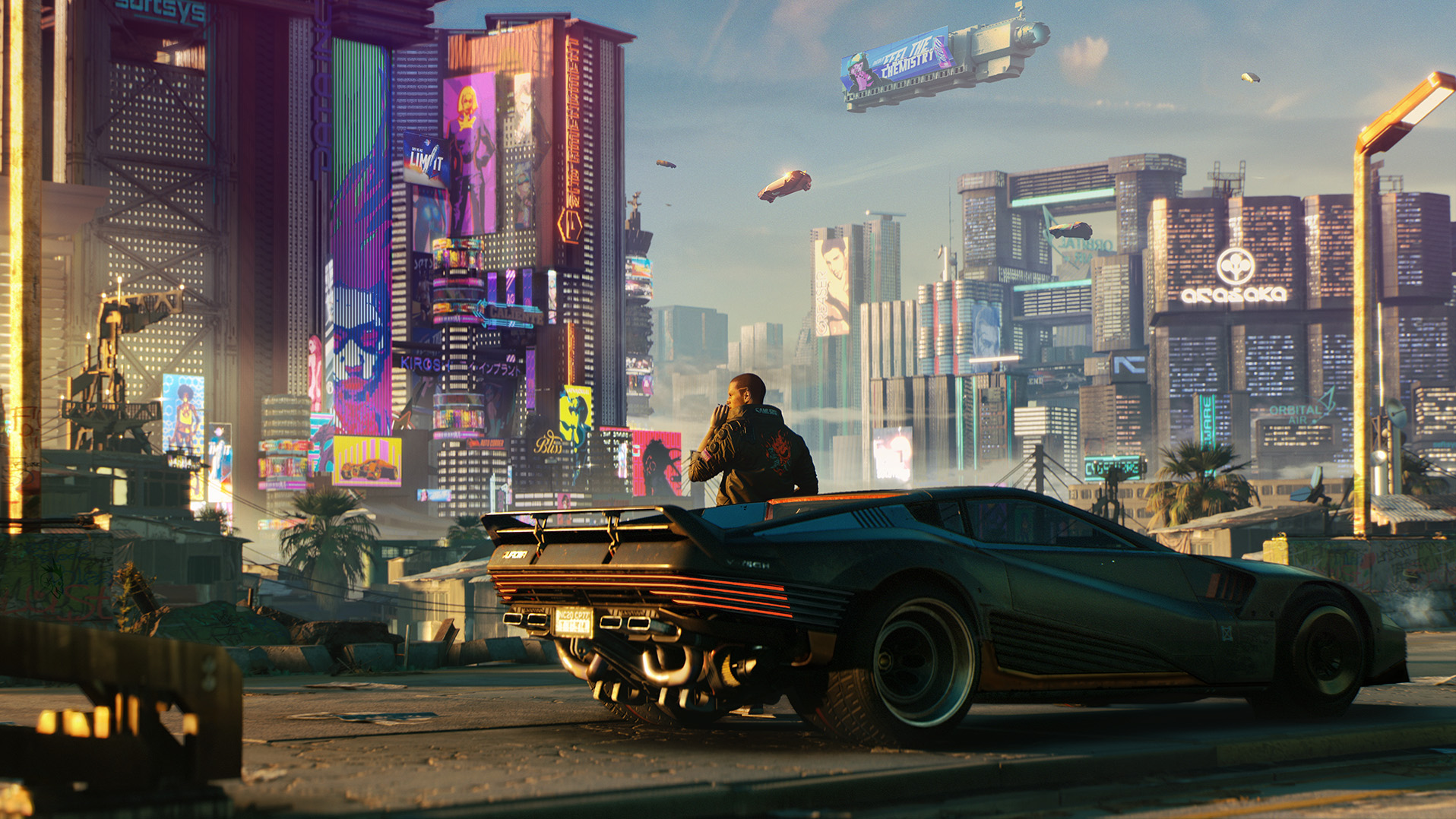
Glass towers rise above crowded streets. Corporate spaces communicate control through scale, polished surfaces, and carefully managed access. Elsewhere, buildings appear crowded with advertisements, improvised structures, and the visual traces of people trying to make a life in places that offer them little room.
The contrast is more than decorative.
The city expresses its social hierarchy through physical space. Wealth is visible in where people live, what they can access, and how far they can separate themselves from the problems experienced by everyone else.
Looking upward can become an unconscious habit.
The tallest buildings suggest that success exists somewhere above the player, beyond the streets where ordinary people conduct their lives. They create an image of aspiration that is almost impossible to ignore. The city does not merely tell its residents that wealth matters. It makes wealth visible every time they look at the skyline.
At street level, however, the dream becomes more complicated.
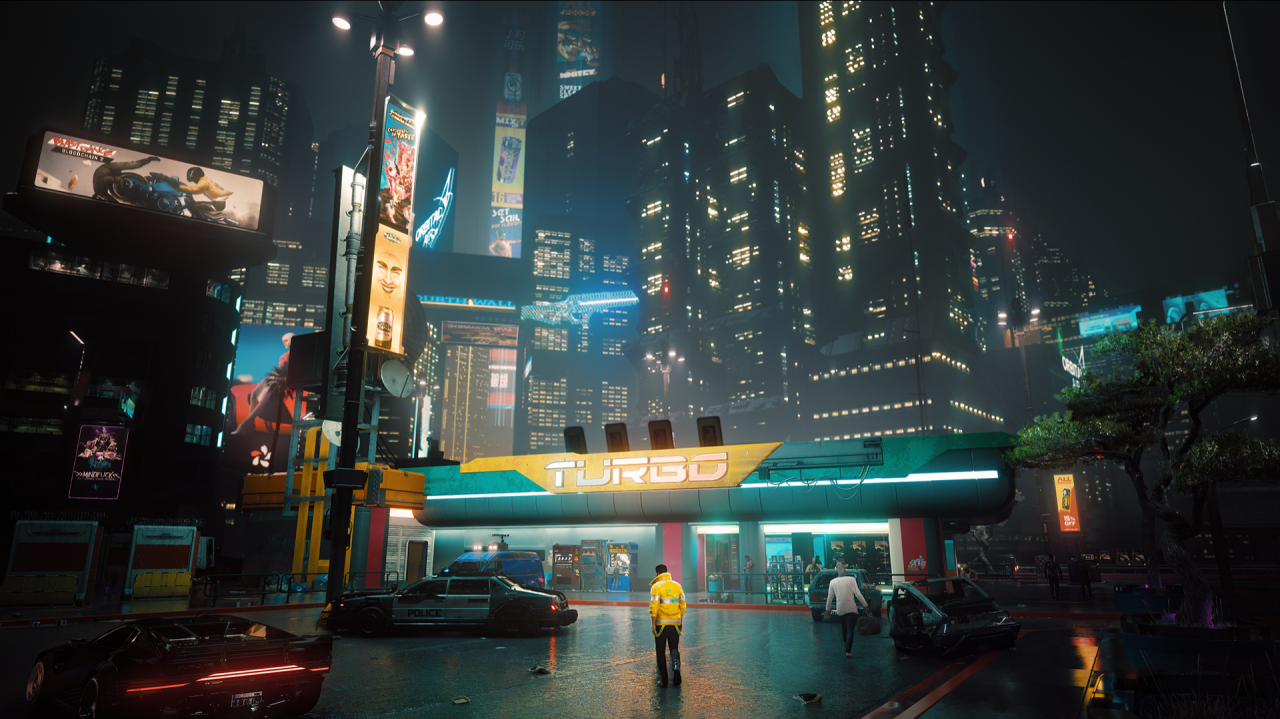
The player moves through crowded commercial districts, residential neighborhoods, industrial areas, and places where danger feels much closer than the distant towers suggest. Night City is not a single atmosphere repeated across an enormous map. Different districts communicate different relationships between wealth, opportunity, neglect, and power.
This variety gives exploration a narrative function.
Driving through the city is not simply a way to reach the next objective. It can reveal the distance between the image of success promoted by the city's architecture and the realities of the people living beneath it.
The visual environment also supports the game's central contradiction. Night City is beautiful, sometimes spectacularly so, but its beauty does not make it a good place to live. The neon lights can be seductive while the circumstances they illuminate remain harsh.
The player can admire the skyline without believing that the world it represents is fair.
That tension is crucial to the setting's identity. If Night City were simply ugly, corrupt, and unpleasant, its temptations would be much easier to resist. Its glamour makes the promise believable. It gives ambition something attractive to pursue.
The city needs to be desirable for its dangers to matter.
And the player needs to understand why someone might choose to remain there, even after discovering how much it can take from them.
9. The Difference Between Leaving a Mark and Leaving Something Behind
Night City's obsession with legends creates a peculiar definition of success.
To become a legend is to be remembered. It means that your name survives beyond the immediate circumstances of your life, that your achievements become part of the stories people tell about the city.
For a mercenary, this reputation can be practical. It attracts clients, establishes credibility, and creates opportunities that would otherwise remain inaccessible. But the idea also carries an emotional promise: if enough people remember you, perhaps your life will have mattered.
The problem is that being remembered and being understood are not the same thing.
A reputation compresses a complicated person into a recognizable image. People remember the most dramatic actions, the most famous victories, or the most notorious failures. The ordinary details that made someone human are easier to lose.
A person becomes a story that can circulate without them.
Johnny Silverhand embodies this contradiction. His reputation remains powerful long after his original life has ended, but his continued presence does not mean that his past has been resolved. The legend is still recognizable, yet the person behind it carries contradictions that cannot be captured by a single image of rebellion.
V faces a related question.
What kind of legacy should a person pursue when the time available to build it may be limited? Is recognition worth sacrificing the relationships that make life meaningful? Does the desire to leave a mark come from a genuine wish to contribute something, or from the fear that a life without public recognition will disappear without consequence?
These questions are especially compelling because the game does not require V to have a single, uncomplicated motivation.
The player can pursue status, money, loyalty, survival, or some combination of all four. Different decisions can reflect different understandings of what V wants to preserve.
The important point is that the pursuit of a legend can become a distraction from the life that legend is supposed to represent.
It is possible to spend so much time trying to become someone important that there is little opportunity left to enjoy being a person.
Night City encourages this confusion because reputation is one of the few things it consistently recognizes. A famous mercenary receives attention. A successful job opens doors. A powerful name can change how people respond to you.
But attention is not affection, and influence is not freedom.
The people who matter most to V may not be the ones who recognize the name. They may be the people who understand the choices behind it, including the compromises, mistakes, and sacrifices that a public reputation would leave out.
That is where the game's emotional conflict becomes more than a story about ambition.
It becomes a story about deciding whose judgment should define the value of your life.
10. Freedom Is Not the Same as Having More Choices
Role-playing games often express freedom through the number of options available to the player. You can choose how to approach combat, which characters to trust, how to develop your abilities, and which activities deserve your attention.
Cyberpunk 2077 offers this kind of freedom through its builds, missions, dialogue, and relationships. Players can shape V's approach to problems and develop a personal style of navigating Night City.
But the story introduces a more difficult question: what does freedom mean when the circumstances surrounding your choices are not entirely under your control?
V can choose how to approach many situations, but the larger crisis involving the Relic limits what those choices can accomplish. Time, information, personal loyalties, and the influence of powerful institutions all constrain the available possibilities.
This creates a distinction between choosing how to respond to a problem and choosing whether the problem should exist in the first place.
A person may have several options while still being trapped in a situation they never wanted. A mercenary may choose between dangerous jobs without possessing a realistic way to escape the need for money. Someone may be free to purchase technological enhancements while living in a society that makes those enhancements feel necessary for survival.
The presence of options does not automatically eliminate coercion.
That idea makes Night City feel uncomfortably recognizable despite its futuristic setting. Modern technology can expand what people are able to do, but greater capability does not always translate into greater control over the conditions of their lives.
The same tension appears in the game's relationships.
V can develop trust with other characters, but trust does not guarantee that circumstances will permit everyone to remain together. People can care deeply about one another while facing incompatible needs or risks that cannot be resolved through good intentions alone.
Freedom is therefore not simply the ability to select an option from a list.
It also involves having enough security, time, and independence for a choice to reflect what you genuinely want.
Night City rarely makes those conditions easy to achieve.
The game does not need to provide a perfect philosophical answer. Its strength lies in allowing the player to feel the difference between having agency and having complete control.
V can make meaningful decisions without becoming the master of every circumstance.
That limitation does not erase the value of those decisions. It makes them more human.
Conclusion
Cyberpunk 2077 begins with a familiar fantasy: enter a dangerous city, rise through its ranks, and become someone people cannot ignore.
Night City gives that fantasy a spectacular form. Its skyline promises opportunity, its technology promises transformation, and its culture treats reputation as a kind of currency. The possibility of becoming a legend is always visible, even when the path toward it is dangerous.
But the city gradually reveals the cost of pursuing that promise.
V discovers that greater power does not guarantee security, that technological progress cannot resolve every question of identity, and that a famous name cannot substitute for a life experienced on one's own terms. Johnny Silverhand's presence complicates the meaning of survival, while the people V encounters throughout the city reveal forms of value that cannot be measured through reputation alone.
The most important struggles are not always the ones that attract the most attention.
Sometimes, they involve deciding whom to trust. Sometimes, they involve accepting that a person cannot repair every injustice they encounter. Sometimes, they require recognizing that ambition has begun to consume the very life it was supposed to improve.
Night City will continue to sell the dream of becoming somebody. It will keep offering new upgrades, new opportunities, new ways to gain attention, and new reasons to believe that the next achievement will finally be enough.